Showing posts with label Neighborhoods. Show all posts

Friday, December 13, 2013

Mom's Apartment

1618 Vista Del Mar reads a hand-written note tacked to the bulletin board above my desk. I only write notes by hand. I had a roommate once who would type notes – reminders, to-do lists, quotes – and then color childlike borders on them with markers before she’d tack them above her desk. A typed, designed note is no longer a note, just as a painting, scanned, printed and rolled into a tube mailer is no longer a painting. The nature has been steamrolled out of it, and now it’s just a poster.

I learned two years ago that when my grandmother gave birth to her first child, my mother, she lived in a building at 1618 Vista Del Mar, right down the street from where I live now. The fact that my mother’s first home on earth was in Hollywood, just a few minute’s walk from the apartment where her daughter would live over a half century later is amazing to me. We’re from Utah. We know mountains and rivers and snow.

Hollywood, City of Dreams, with its constant din of noise and light, its coyote-filled hills, its imported cars and palm trees, A-list Lounges, and sordid motels, is not our territory. It’s been so printed and re-printed, it’s like a poster that you can walk around in. Yet, as it turns out, we’ve got roots here. My grandmother, going into to labor with my mom, took the bus by herself from her apartment to the hospital on Mid-Wilshire – that’s putting down roots.

1618 Vista Del Mar
Below the scrawled 1618 Vista Del Mar note is a blue leather desk organizer, from which stretches a stack of medical bills. I relegated them to the back of the organizer as I’d hoped to do in my mind, but I stood them upright so that I wouldn’t forget the thing one must remember about bills – to pay them. Every time I look at them, I tell myself that I ought to organize them, pay those remaining to be paid, and file them away for good. But there they stand. I may be residing in a city of dreams, but life doesn’t know it.

After all, I’ve got roots here: in front of the medical bills grows a cluster of journal entries that I wrote during my treatment for thyroid cancer. I’ve been tearing the entries out of the journal, because its pages are graphed, and I can’t stand writing on such regimented lines. I’ve been saving them in the organizer, where they obscure the bills. Their edges are torn and frayed, having had a difficult time releasing from the bookbinding. I’ve always had a soft spot for torn paper with its sharp edges turned cloudy. My notes, in addition to being hand-written, are usually scrawled upon torn scraps, their imperfect form reminding me of nature - of mountains, rivers, and snowflakes tacked to the bulletin board above my desk in Hollywood.

After living here for two years, I’d grown to like the neighborhood for its contradictions and justifications, but learning of the nearness of my mother's infant years caused me to love it with a fierce protectiveness. Finding the actual building in which she had lived, still tucked behind that sprawling parking lot south of the sidewalk that is tiled with celebrity names, under the unremitting lights of Hollywood and Vine, was a real full-circle moment. My adoptive city was no longer adoptive – it was a part of me, and while navigating its roads from hardship to health, I had become a part of it.

Tuesday, October 15, 2013

Weekdays

On Tuesdays and Thursdays, I drive to Pacoima, in the San Fernando Valley. From Hollywood, it’s only 15 minutes in good traffic. I teach theatre at a charter school there twice a week. The air is hot and dusty in Pacoima, the streets are wide, and the trees are few.

On Monday and Wednesday mornings, I work out of the LA Weekly offices in Culver City, on the West Side. I have meetings at Culver Studios on these days as well – near enough to be close, but not near enough to make the travel time between them disappear. The air is soft and moist in Culver City, the streets are illustrated with colorful storefronts, and the trees are green and many.

Monday and Wednesday and Thursday evenings I spend at the University of Southern California, in Central L.A., in class or in meetings. The air is dirtier than dust, the streets are crowded, impatient, and the trees are exclusive to campus.

Tuesdays have me at Culver Studios in the morning, and from there I drive to Pacoima in the afternoon, on the 405. The freeway isn’t terrible, in the middle of the day. The drive is quick, and I enjoy the passing view of The Getty, and Laurel Canyon. Is that Laurel Canyon? I’m not sure, but I like it.  Its golden, rolling hills and hiding, curving roads makes me think of filmmakers and actresses.

Thursdays have me driving from Pacoima, after my class, to USC. I check my phone first, to see if the 101 Freeway will be faster than the 5. Silly to drive all the way around if I don’t need to, but often I do. When I don't, I inch past the Hollywood skyline – Capitol Records, Hotel Hollywood, the W, and wish it would all go faster. But just today. After today, don’t move, don’t change. Grow only in spirit, not in size.

I get off at Exposition Boulevard, and am filled with promise at the sight of heavy brick academic structures: The California Science Museum, The Natural History Museum, the lower end of the University, its grandest entrance off the metro line. I turn on Figueroa and park near the Felix the Cat auto dealership. I still don’t know what kind of dealership it is, or why Felix is its mascot. I don’t care, as long as it always remains.

Mondays and Wednesdays, I drive to USC from Culver City. I take Adams usually, sometimes Jefferson. Driving Adams is like navigating a box of crayons. Painted yellow carnicerias and blue mechanic shops, pink party supply shops, magenta-marquied dance halls and vibrant, multi-colored murals in green, overgrown empty lots greet me along the way, like celebratory bystanders of a marathon. Jefferson feels a lot like industrial North Brooklyn, but with faster traffic, and no time to see any of it. Muted red brick, cloudy white commercial glass, and rusted train tracks criss-crossed with nasturtium remind me of the distance I’ve journeyed.

Fridays. Fridays I am asleep.


Wednesday, March 20, 2013

A Collection of Towns


It is colder in Culver City than Hollywood, and less sunny, generally. I take the bus and the train in the mornings, and as I travel, I feel the degrees falling away, see the fog hanging down.

Downtown Culver City bustles with pedestrians. People walking from work to lunch, people eating healthy lunches at sidewalk cafes, moms walking their pre-school aged children or their dogs. (There's one mom who walks around with her three year old girl who always carries a flower in each hand and does princess dances all down the street.)  It feels like a city, albeit a very small and quaint one, with groomed landscaping and social flow - like The Truman Show's Seahaven or Back to the Future's Hill Valley.

Los Angeles is a city of neighborhoods. Some call them pockets. Each little pocket has a strip. A strip is made up of five to seven shops, one or two bars, a restaurant and/or a cafe. When people ask, "Do you know Los Feliz?", they're usually referring to the two-block strip of Vermont Avenue.

Downtown Culver City has one major strip, and two off-shoot strips. There might be five cool restaurants in the area, and several good lunch spots. It also has two performing arts theatres, one movie theatre, an In'n'out, a Trader Joes, an Office Max, a Ross Dress for Less, some nail salons, and two studio lots.

It's only a city due to population, and through-traffic (all that east side to west side or vice-versa traffic that is either going to or trying to avoid the freeways). Otherwise, it more accurately resembles a large town.

This is Los Angeles, a collection of towns called cities that collectively make up one giant metropolis, if a metropolis can refer to something sprawling and incomprehensible.

Greetings from LA.  We're on our way.

Wednesday, March 13, 2013

Again About Transit

My old apartment was half a mile from the Hollywood/Western station. My new house is over one and a half miles from the Vermont/Beverly station. Too far to walk for a typical commute, but I will not be unfazed.  For my commute to Culver City, I have my husband drive me to the station, or I take a Metro Rapid bus down Western avenue to connect with the Expo Line.

The Vermont/Beverly station is landscaped with drought-resistant desert plants along a walkway that runs behind the escalators that descend to the subway. It's got steps and levels and foot traffic flows easily through.

1993 Artist's rendering depicting the entrance of the Red Line station at Vermont and Beverly

Vermont/Beverly entrance 2013. The landscaping is very close to the artist rendering above.


Now, let's look at Hollywood/Western:


1993 artist's rendering depicting the entrance of the Red Line station at Hollywood and Western.

Hollywood/Western 2013
Comparing the artist's renderings for Hollywood/Western to how it turned out, it is hard to imagine how things went so wrong. Tiles and stone beneath a terribly dated low-income housing project. Despite the attempt at color and design, the corner is bleak as compared to the life (as in, plants, actual, breathing life) at Vermont/BeverlyOf course, the artist's rendering shows no housing unit, which is a necessity for the area, but how on earth did the actual development turn out to be so, so ugly?

Back to the bus, Metro Rapid 757 stops at the south-west corner of Melrose and Western, in front of a gas station. It is not a pretty corner. It is trash littered and hot. The bus is always crowded, standing room only, but it's a core-strengthening, balance-challenging kind of standing. I can count it as part of my exercise routine.

Nearly five years ago, when I used to take the train downtown to my job at The Unusual Suspects Theatre Company on Olive Street, I was often the only business-class person on the train, and it was never crowded. The majority of riders were families (lots of non-car-owning moms with their babies) or workers of the non-office sort, judging by apparel. No suits and ties, I mean. Sprinkled lightly within the crowd would be one or two FIDM students in their artsy, stylist get-ups.

Today, the ridership has greatly increased, and there are often no available seats on the red line (the expo line is still gaining riders, and finding a seat is never a problem).  The most marked difference between now and five years ago are the number of suits on the train. Professionals are commuting downtown by Metro.

Five years ago, there were fewer companies operating out of downtown.  Many companies didn't think it was a desirable place to be. With the revitalization of Downtown, came a shifted perception, and it became a cool place to be. "You work Downtown? Bleh," became "Wow, you work Downtown? How hip."

Gas prices have driven people out of their cars and onto their feet, and has also driven them into neighborhoods near metro stations.  This shift was fairly predictable.  After a few decades of people wanting space and isolation as well as city salaries, rising gas prices and recessions turned their desires from the suburbs to city centers  - where to get groceries or go to the movies or get drinks with a friend, all you have to do is walk out your front door.

The Metro Rapid ridership is still comprised of the demographic on the train five years ago. I don't know why the business class isn't on the bus. I wonder if it's because the street atmosphere of my particular nook of East Hollywood (Western Avenue) just isn't pretty.  Urban design and aesthetics go a long way to get people of all sorts onto transit - those who need it because they don't have a car, as well as those who have the privilege to choose to not get in their cars. Maybe it's the jostling. A crowded bus does cause a person to jostle, especially when it's charging down Western Avenue.

I know I write about public transit a lot.  That's because I'm on it a lot. And I'm on it a lot because it's a far better way to get around a city, to plan a city, to design a city, than by car.

Wednesday, February 27, 2013

The Millennium Hollywood

There are stretches of parking lot in Hollywood.

(If you know Hollywood at all, you just rolled your eyes as you read that. Duh, a lot of Hollywood is parking lot.)

The stretches of which I speak surround the Capitol Records building.

Imagine turning these bleak parking lots (are there any other kind) into development.  A landscape upon which life can happen. Shopping! Dining! Or, my personal favorite (and the least mentioned): a park!

A proposal is currently circulating City Hall to develop these lots into a mixed-use project comprising apartments, shopping, dining, and public areas. It sounds wonderful, in theory, but when further details, including architecture renders, emerged, a loud voice of dissent arose from the community, mine among them.

The renders show two 50-story towers stretching to the clouds, dwarfing all the other buildings at Hollywood and Vine - indeed every building in Downtown Hollywood.  The towers look unfinished, with the balconies carved into columns on either side resembling the crossbars of construction scaffolding. According to plans, the towers could be as tall as 485 and 585 feet — more than twice the tallest building in Hollywood (the CNN tower).


However, the final architectural plans for the Millennium Hollywood (by developers Millenium Partners and Argent Ventures) have not yet been approved.  The latest progress in the Millennium Hollywood project is its recent approval by the city's planning department.  Just a, "okay, we're interested, let's talk seriously about this."

The Millennium Hollywood project will be split between two parcels across the street from each other, along Vine between Yucca and Hollywood (almost 5 acres of land).

The two towers will be designed by Handel Architects, and the neighboring Capitol Records Tower and the Gogerty Building will be preserved with the expertise of architect Bill Roschen of Roschen Van Cleve Architects.  The towers will "frame" the views of the Capitol Records tower.  Millennium Partners insists that the project’s primary design objectives will be to "preserve, complement and highlight the Capitol Records Building by creating extensive and inviting open spaces that will greatly enhance the pedestrian experience of the area and forever preserve the critical views of one of the 20th century’s most recognized and beloved structures."


A more pedestrian-friendly experience in central Hollywood would be a much-needed improvement to not just the immediate area, but, with the Hollywood and Vine metro station just a few blocks away, to the progress of a more transit-oriented city at large. I love living in central Hollywood because I can walk to restaurants, bars, and shopping, and there are other people on the street doing the same thing. And then I can get to other parts of town without having to drive.  Hollywood feels like a city, but just a hint, a feeling, a potential of a better, more metropolitan one, if only there were more people, more restaurants, more bars, more transit options, and more public space with benches upon which to sit.

“The goal of all of our projects is to attract people who embrace an urban lifestyle. They want to be able to walk out their door, walk down the street, go to a restaurant, go to the movies, come home, ride the elevator, look at the Hollywood Sign from their apartment, go to sleep,” says Philip Aarons, the Founding Partner of Millennium Partners.

Roschen and Handel Architects are collaborating with James Corner Field Operations, landscape architects of New York’s High Line (a bastion of successful urban public development), on the design of the Millenium's open space, comprised of street-level plazas enhanced with retail and shopping.

Again, all of this sounds wonderful, aside from the hideous tower renders.  I will hope that project can be kept to scale with the current Hollywood skyline, so as to provide housing without adding significant congestion. (50 stories and nearly a thousand apartments and hotel rooms means twice as many thousands of cars - let's not forget, that even with a nearby metro station, this is still LA, and people need cars. You still can't get to Santa Monica from Hollywood without one, or without at least incurring a suicidal headache.)  I will also hope that the Millennium Partners are sincere in and capable of providing the pedestrian-friendly experience to which they allude.  Other developments have promised this, but have failed at delivering. Take, for example, California Plaza. It is nice when you're inside it, but it's above sidewalk level, so if you're walking down Grand or Olive Avenues, you have no idea that there's a large open space just up these stairs here or down these ones here or behind this building or this hotel. The same goes for the Dorothy Chandler Pavilion. Lovely on the inside, but from sidewalk level, it's a big secret. By contrast, Lincoln Center in New York City can't be missed by a passer-by. You see the plaza from Broadway, you see the lights inside the Metropolitan Opera house and the intermission audiences gathering outside, you see the fountain dancing, and the New York ballet students lounging around it and you want to go in and discover it for yourself.

Due to an unchecked scale, and previous LA mishaps in providing a pedestrian-friendly experience (my eyes ache from the rolling they've been doing each time I hear a proponent mention Hollywood/Highland as an example of good mixed-use development) , I am skeptical of the Millennium Hollywood.

I would love to hear your thoughts. What do you think of the plans? What would you like to see developed on these parcels of parking lot? What do you think would best help usher Hollywood into being a more urban center? Do you care for it to be such?

Sound off, please.

Monday, February 4, 2013

We're Home!


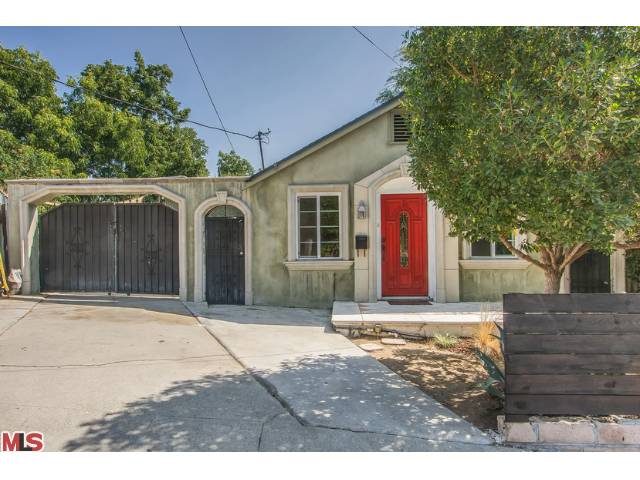
This is our home. We own it. And it's in Hollywood, where we've said we'd like to stay forever. We're so happy to be home.  Now, let's take a walk down memory lane: our house hunting experience that lasted three years and caused our hearts to ache and our eyes to swell with tears. I'm not exaggerating.  We looked at hundreds of homes, and bid on about a dozen. Here are the ones that stand out.

This was the first house we bid on. It was in a neighborhood we'd never heard of before: Glassell Park. It was up in the hills, with a gorgeous view of Mt. Washington. The house was tiny. But the yard! And the finished back house/studio/office!  And the jacuzzi!  It was an oasis. In East LA.  It sold for $60,000 over listing price.


Next, we bid on this house just off of Beverly. Two stories. A real home. Little yard, but big enough. I loved this house; my husband not so much.  But he didn't have to worry. It also sold for $60,000 more than listing price.


This was our dream house. In the heart of Hollywood, in walking distance to Hollywood and Vine, to our gym, to the farmer's market. Sure, the house needed serious work: new floors, a new kitchen, a new bathroom. But we were willing to slum it over time, to create our dream home with our bare hands.  Although we were the top bidder, we were passed up for a cash buyer.


We really thought we were going to get this one. We wrote a cover letter to the owners, they seemed to really like us - they were like the forty-something versions of us. But, they went with a cash buyer. This is when Joseph coined the term "cash holes".


This was almost our dream house. It wasn't in Hollywood, but it was in a super cute neighborhood (Baldwin Hills), walking distance to the Expo line, and was BIG. Two bedroom/two bath, big front yard, huge back yard, huge back house. We were the top bidder. We went into escrow. The house appraised low. The selling bank wanted us to pay the difference in cash. We said no. They canceled our contract.  Our hearts broke and we became angry at the whole damn system.


State of the art, this was. Gorgeous. Like Tuscany. It was in Highland Park, LA's hottest 'hood for young home buyers. We didn't have a chance in hell.


In Frogtown, almost my favorite neighborhood outside of Hollywood. Tiny, but super cute. A million bidders entered the game. We had a little bit of a chance on this one, but not enough.


Also in Frogtown, on the same street as the one above. At this point, we were desperate to find a home in Frogtown. Near Echo Park! Right off of the LA River bike path! So quiet! So cute! Yeah, us and everyone else.


Again, in Frogtown, right off of the river. With a gorgeous, landscaped backyard. Oh, it was beautiful. Again, like Tuscany. Again, we didn't have a chance.


This is not all of them. Just the ones that we really, really wanted. After three years, hundreds of viewing, dozens of bids, we wound up staying in Hollywood, which is what we wanted all along.


Hollywood forever.

Monday, January 28, 2013

Parklets Come to Los Angeles

Highland Park parklet rendering, courtesy of Office of José Huiza
Parklets!

What's a parklet? It's a mini public park in an urban area.  Essentially, it's a great idea.

Last Friday, the L.A. City Council approved the construction of four parklets in Downtown L.A., El Sereno and Highland Park.

This is great news for our city, as it signals a move toward prioritizing open space.

What is open space? Open space is any open piece of land that is undeveloped (has no buildings or other built structures) and is intended solely for public leisure. (That's my own definition - feel free to provide your own.)

Los Angeles has a severe lack of open space.  We need more. Much more.

So, yay for parklets!  If ever the city council approves more, where would you like to see one?

I would love for there to be a parklet on Melrose, somewhere east of Fairfax, west of La Brea. You know, where all the (affordable) shopping is.  Los Angeles lacks good, urban shopping districts. Melrose is a good one, but there's nowhere to grab a bench!  Think of good shopping districts in other cities: Union Square in San Francisco, Herald Square in NYC, SoHo NYC, L.E.S. NYC. All have lots of little parks with benches. You know, to sit on. To rest on.  To survey your city on.  What a novel idea. Except that it's an idea as old as civilization, and has been proven, over and over again: parks (or parklets) are essential to a city's quality of life.

Friday, August 3, 2012

The City Prolific: Weekend Events August 2 - 4

Sand, sun, and stars: I saw a lot of each last weekend.  Went to the Nick Waterhouse show at the Getty, and spent a good portion of the time looking up.  The sky is so big over those Santa Monica hills.  I also got a lot of sun. Went to Huntington Beach with my SoCal cousins, and played in the sand with the littlest one, as seen below.


It's August now, my favorite month. Its days cast a wash of deep yellow, my favorite color, 3:00pm yellow, hottest time of the day yellow. Again this weekend, everyone in LA is outside, absorbing the late summer sun at screenings and festivals.

FRIDAY, AUGUST 3

First Friday At The Refine House (Art Show)


Refine Mixers is hosting a specialty “First Friday” where they will serve complimentary Refine specialty low-calorie cocktails for guests to enjoy while mingling amongst the artwork of Renowned artists Louie Ferrigno Jr. and Kelcey Fisher.

Free
8-10:30pm

Refine Mixers House
619 San Juan Ave
Los Angeles 90291

Oscars Outdoors Presents "North by Northwest"


Oscars Outdoors is a summer screening series at the Academy of Motion Picture Arts and Science’s new open-air theater, located on the Academy Hollywood campus. The series features a permanent 40’ x 20’ screen, a 10,000 square-foot plaza, and lawn seating (blanket or low chair). Food trucks are curated by Roaming Hunger and tailored to the movie showing whenever possible.

For sold out films, a standby line will form on the day of the event, and standby numbers will be distributed at 6pm; available tickets will be sold at approximately 7:45pm (grab happy hour at Wolfslair Biergarten while you wait). Ticketholders should plan to arrive at least 15 minutes before the start of the event to ensure a seat at the venue.

$3-5
Gates open at 6:30pm, screenings begin at sunset.

Oscars Outdoors
1313 Vine St
Los Angeles 90028
www.oscars.org

Wednesday, August 1, 2012

The Exercise of Meandering

I wrote about walking recently, and it's been on my mind a lot. On my mind, because it isn't in my life as much as is necessary to not think about it.

Some years ago, I would alter my after-work journey home with the errands I wanted to run.  I'd zing down the 6 to hit up The Strand Book Store, and then wile away the last hour of dusk in Union Square Park or window shop along 5th Avenue before hopping on the L train home. I'd walk over to Central Park to pick up a new read at the used book stand on Central Park South, and then take the F to 42nd Street and wander over to Grand Central Market to pick up a little gourmet something for dinner.  Or I'd take the F to West 4th and grab a cocktail at Do Hwa and then indulge in a cupcake at Magnolia ($1.25 at the time seemed extravagant), before moseying around the West Village until I was ready to go home.

I guess it's both walking and public transit I'm talking about: the foot-to-ground, visceral connection to a city, literally mapping your community with the soles of your feet, public transit serving as a means to speed up the journey while keeping you contained in an area only as big as yourself (you get in a car and you're twenty times your regular size, requiring a lot more space and energy).

I got tired of being underground so much, though, especially when I lived in Brooklyn. In Manhattan, I could walk or bike everywhere, the train simply being the quicker option.  In Brooklyn, the train was my only option (I'm not a gung-ho bicyclist, and was never prone to riding over bridges, nor was I near enough any of the bridges for this to be an efficient mode of transit).

In LA, I am above ground, and I see a lot of sunlight and trees, which is an improvement over the dripping concrete ceilings and rusted pipes of NYC subway stations.  However, I'm always just where I am, or going there, usually in my car.  I'm never meandering. Oh, to meander. I miss it so.  I regularly attempt it, often spending my lunch breaks wandering around the Hollywood and Vine area. It's a fascinating stroll of opposites - urban and suburban, industrial and corporate - but it has no parks. Nowhere to sit, reflect, absorb. When I get back to my office, my legs are very tired, my shoulders browned by the sun, my forehead flecked with sweat.

Walking in LA. It's an exercise, in more ways than one.

Thursday, July 26, 2012

Grand Park (One Step Closer to a City for Wandering)

Walking in Los Angeles. Some say it's an oxymoron. Others say it's an impossible daydream. Some have never even heard the phrase.

We, myself and my husband, walk an awful lot. We're lucky. We live in Central Hollywood. We bar-hop around Hollywood and Vine, all along the Walk of Fame, as far as Sunset and Highland. We walk into Los Feliz, to see movies, to go out to dinner, to shop.  We take the Red Line downtown to hit up pool parties and festivals and dine in Little Tokyo or the multiple of restaurants in the Old Bank District.

Our walking is different here than in other cities, though. It's more of a destination-driven mobility.  We know exactly where we're going, and we walk to that specific place. When we've decided to leave that place, we determine what our next stop will be.  In other cities, New York, Paris, Madrid, even San Francisco, there is no need for a destination before our legs begin to carry us, our feet treading great ground.  When we are ready to leave Max Fish, we may say, "where do you want to go next?" and our answer very well may be, indeed, usually is, "I don't know." We wander. Up Avenue A. Passing East 5th, we may say, let's see what's going on at Ace Bar.  Or not. We keep going. Grabbing an Italian Soda on East 7th, we sit in Tompkins for a bit. Maybe head over to Cooper Square, maybe sit in Washington Square for a bit, maybe down to SoHo, there is no end in sight.  "What are you guys doing tonight?" "Nothing. Wandering." It's a way of life.

A major aspect of this life, perhaps the very most significant one, is the abundance of parks. City parks. Big or small, size doesn't matter. It's about landscaping, with places to sit.  Los Angeles is terribly lacking in parks (no shortage of empty lots and parking lots, though).  Our open space exists in the form of foothills and mountains, which, though great for hiking, don't offer the urban respite of city parks. Wandering, strolling, experiencing a city on foot, forming a visceral connection to a city in both body and soul, requires the existence of parks - open, landscaped space to sit and rest and reflect upon the city around you.

This weekend, the city opened the initial phase of Downtown LA's first major central park.  Grand Park sits on twelve blocks that connect the Music Center and City Hall.  Previously, those twelve blocks contained the old County Mall, a concrete plaza, and a parking lot.  Now, they contain a new wade-able membrane pool, a small intimate performance lawn, a community terrace planted with drought tolerant specimen plants, a grand event lawn, the re-designed fountain of the old mall, now made interactive for adults and children to play in, and ample avenues for strolling, via a series of stairs, accessible ramps and sloped walks.

The first phase of Grand Park's opening took place just today, and already the twitterverse as well as local blog comments sections are a-heat with criticism about whether this is the 'right' spot for a central park, about the price tag ($56 million), and whether or not such funds could have been put to better use by building multiple smaller parks in poorer areas.

I wonder, though, what could possibly be wrong with building a park Downtown. Downtown is not a rich nor a poor area. Every type of person from every social strata finds themselves in this area of Downtown, near the Courthouse (jury duty), the Music Center (opera and theatre), and Grand Central Market (cheap groceries).  We need a park there. And now there is one - a grand one.

Yes, we need more parks, in more areas, but at least we now have one more than we had before. Let's celebrate by grabbing a horchata from Grand Central Market, meandering on over to Grand Park, and taking a seat on one of its magenta lawn chairs. Maybe one day we'll be able to say it is possible to be a flaneur in LA.


Read more about Grand Park here:

http://grandpark.lacounty.gov/ 

http://www.latimes.com/entertainment/arts/culture/la-et-cm-grand-park-review-20120725,0,6792713.story

Wednesday, July 25, 2012

A Pool of Nostalgia

Sometimes I have trouble sleeping.  I blame it alternately on anxiety and muscle pain. A few nights a week, I lie in bed, a tired person trapped in an awake body.  On nights like these, I often don’t fall asleep until four or five o’clock in the morning.  Then, because I don’t want to sleep the next day away, I awaken at a typical morning hour, and spend the day in a near-zombie state.  Such was the case last Sunday.  Moving, but barely alive.

I’ve been running. I started as an excuse to workout outside rather than at the gym.  I trained for a 5K, and then a half marathon. Now I’m training for a marathon.  The conditions have to be just right for me to go running. It can’t be too hot out, but it has to be sunny. It also can’t be morning, because I am asleep in the morning.  Therefore, I mostly run in the evening, after 6:00pm, when temperatures have cooled and the sun has softened.

Last Sunday, I was milling about my apartment in that sleepless zombie state, trying to muster up the energy to go for a run.  By the time I'd finally talked myself into it, it was past noon, and just too hot out.  There were other options. The gym. Hiking up to the Griffith Observatory. Yoga. But I was so tired, I just wanted to float. Outside, resting my muscles under the summer sun, while still moving them in a manner that could be considered good for them.

It dawned on me that I could go swimming. There is a public pool in Hollywood, on Cahuenga. I've only been once, under a very similar circumstance - I was prepping for a round of cancer-treating radiation. Exhausted, but knowing I needed to move, and wanting to do so outside. It was, after all summertime.

I am meant to be outside. The very molecules that make up my physical being are made of fresh air, fresh water. I'm kin of snowmen but from a different climate.  A life spent inside is for me, no life at all. I'd melt.

So, I put on a swimsuit, packed up a beach bag, and drove myself to the pool. I remembered all of my days spent walking to the pool when I was a kid. In grade school, my sister and I would walk a full two miles to the pool in Riverton, Utah, through the small suburban town, into the rural outskirts, past the farms and empty fields, where there was a beautifully landscaped public pool overlooking the Jordan River valley.  Later, I lived in an even more suburban area called Sandy.  No farms, just houses.  There were two pools in the area - the grander one was two miles away, at the end of Highland drive, a major thoroughfare that climbed steeply from my culdesac.  It wasn't a pleasant walk.  The smaller community pool was just under two miles away, along Creek Road. A simple, pretty walk.  In junior high school, I spent my summers in Montana, on a small town swimteam. My friend and I would often walk home from the pool, two miles along a country dirt road through the rolling golden hills of Chinook's expansive farms and ranches. We'd spend the entire day in our swimsuits, running around on the farm, never minding the dirt accumulating on our knees and elbows or the hay in our hair, because we'd just shower it off at the locker room before evening swim practice.

My time spent walking to the pool was time spent really feeling the sensation of being alive, of the sun on my skin, the coolness of the water, the invigoration and fatigue of my muscles, my pruned fingertips, my hunger, my crusted hair, my cracked heels from walking long distances in worn-down flip flops. Last Sunday, as I dipped myself slowly into the cool almost cold water, all of these sensations came flooding back. My heart jumped with gratitude for these memories, and for my psyche having gotten my tired self to the pool, allowing this nostalgia to take hold.

I also remembered how nice the pools are in the Salt Lake area. Maybe it's because the Salt Lake City economy isn't suffering like the Los Angeles economy. Maybe it's because the Salt Lake area is zoned into many small counties, whereas Los Angeles County is sprawling and unmanageable. In any case, Utah pools are landscaped with lawn and hills and trees. Los Angeles public pools are not landscaped. They are simply holes dug into the ground, surrounded by flat concrete surfaces, and enclosed by chain link fences.  They are only open from mid-June to mid-August (whereas Salt Lake pools are open through Labor Day).  You'd think, given the stereotype that Los Angeles is a blossoming summerland all-year-round, that its pools would be lavish and fancy and open most of the year.  That may be true for the private pools of the rich and famous, but the public pools are quite bland and under-staffed. That being said, the Hollywood pool is clean and well-kept, if not terribly pretty.

After my afternoon swim, I put my wet, chlorine-encrusted self back into my car and drove home with the windows open. "Next time, I'll walk," I thought.

Hollywood Recreation Center Pool

Alta Canyon Sports Center Pool, Utah

Friday, July 20, 2012

The City Prolific: Weekend Events July 20 - 22

Last weekend, we saw Sonny and the Sunsets and The Allah Lahs at Levitt Pavilion in MacArthur Park. MacArthur Park is a star of city parks, on par (landscapingly speaking) with any you can think of - Dolores, Alamo Square, Union Square, Bryant Park, maybe even the Luxembourg Gardens.  Unfortunately, it has spent the past few decades being synonymous with crime, and, with our city totally lacking in budget, uncleanliness.  It's on the mend, though, and the Levitt Pavilion events are helping to put it back on our mental map.

We put out a blanket, ordered pupusas from the Mama's Hot Tamales tent, poured ourselves a couple of inconspicuous cocktails, and watched two great bands perform against the sunset.


LA loves movies, and during the summer we show it. Most of this weekend's events are, once again, outdoor screenings.

FRIDAY, JULY 20

Unique Movie Night: Fasttimes at Ridgemont High


Everybody loves the 80's, and we all miss those angsty 80's teen comedies. Tonight, Unique LA screens Fasttimes - oozing with 80's kitsch, it is also, may I say, a rather depressing flick.

The hosts will hold a Jeff "Surfs Up" Spicoli impression contest, so, as they say, "start working on your stoner-surfer talk"!


$10 online/$12 at the door

Ticket cost includes free drinks (both non-alcoholic and alcoholic). There will be a curated selection of local food vendors who will have dinner items and sweet treats available for sale.

Doors open at 7pm / Movies start at 7:30pm sharp

Mosaic ArtSpace in the Arts District
826 E 3rd St.
Los Angeles, CA

Oscars Outdoors: Pillow Talk


Summer screening series at the Academy's new open-air theater, located on the Academy Hollywood campus. This beautifully landscaped plot of land behind the former super-dumpy Big Lots is a gorgeous addition to the neighborhood.  What makes this screening series stand apart from others is that each film is preceded by an introduction by and little discussion with with an industry professional who worked on the film being screened.
Food Trucks provided by
Roaming Hunger. Trucks will vary each night and will be tailored to the movie showing whenever possible.  Lawn seating – blanket or low chair. 

Tickets are sold online at www.oscars.org. For sold out films, a standby line will form on the day of the event, and standby numbers will be distributed at 6pm; available tickets will be sold at approximately 7:45pm.

$3-5
Gates open at 6:30pm, screenings begin at sunset.
Free parking for advance ticket holders.

Academy Hollywood
1341 Vine Street, Hollywood
Enter from Homewood Avenue (turn west off Vine Street).

Tuesday, July 17, 2012

Vintage Photo: Hollywood Truck

Photograph of Vine St and Homewood Avenue in Hollywood, 1952.


Oh, I mean, 2012.  As in, yesterday, on my daily lunch time stroll through the neighborhood.


My dad knows cars. He can tell a car's make, model, and year with just a quick glance. I'm not sure how to describe his knowledge of cars. None of the words I can think of accurately describe him and his relationship to cars. Enthusiast, aficionado, connoisseur, none of them seem right. He just KNOWS:


Saturday, June 2, 2012

Reverence to Parking

Our landlord took down the garages of our 90 year old building a few months ago.  The garages were small, three connected rectangular boxes housed in a cute little barn-like structure.  Each unit had double barn doors, and a parking space in front.

We used our unit as storage, and we had a lot in there.  When our landlord informed us that he'd be taking the structure down, we were not only inconvenienced, but saddened that our building would be losing an appendage of its historical design.

His reason for taking it down was to make way for one more parking space. Essentially, he'd be turning the footprint of the garage, and our little back-yard area into a concrete parking lot.  He'd even be tearing down a perfectly good tree. All for one additional parking space.

Here in Los Angeles, parking spaces are revered. Like celebrities-of-the-week, or sensational headlines,  hot-button issues or national fads, everyone hunts them, covets them, hoardes them, territorializes them.  When it comes to parking spaces, we're a demoralized band of zombie paparazzi.

In the case of our landlord, a single parking space holds more value than a useful and aesthetic 90-year old structure.

On the day of the demolition, when the work crew had fully knocked the thing down and swept clean the naked concrete lot, a crowd of neighbors gathered to take in the change.

"How great!" One woman said. "More parking!"

"Cool. More street spots for us," her friend agreed.

"I'm a little sad about it," I said. "I liked the garage. It was a lot prettier than this parking lot."

They blinked.

"I mean, it's not like it didn't serve a purpose. We all used it for storage."

"Ohhh," They said.

I don't believe it is silly for me to mourn the demolition of a building, if even a small one.  Los Angeles exhibits much too much ease when it comes to demolishing buildings, and it gives not one thought to history or the aesthetics of design.

Just look at the case of the The Lot.  A historic film studio founded by Mary Pickford, and still in good shape and operating as a film studio up to the last minute, it is now, ironically, just an empty lot.

Empty lots are as abundant in LA as parks are in San Francisco and New York.  Many of these empty lots become parking lots, as in the case of the burned Basque Nightclub at Hollywood and Vine.  The nightclub occupied the Laemmle Building, which was built in the International Style in 1932 by architect Richard Neutra for Carl Laemmle, of Universal Studios fame.  Although it had been altered many times and retained few of its original features, it was a hell of a lot prettier than the asphalt lot that sits there now.  Sure, a fire that completely destroys a building leaves no hope for its preservation.  However, perhaps we could build something equally aesthetic in its place, rather than giving the footprint over to a private parking lot management company.  I know these things take time, but I also know that there are no plans to replace the Laemmle Building.  So, where Hollywood and Vine was once four-corners of historic, metropolitan buildings, it is now three buildings and a parking lot.

But, you say, parking is valuable in a city dominated by cars.  Yes, I say, and therein lies our problem. Perhaps if we expanded our metro system, we could recover our pride, once again placing our values upon city planning and civic design.

Friday, June 1, 2012

The Unexpectedness of Hollywood

It was a Thursday.  We'd both had it with our work days.  We both needed sunlight.  We both needed drinks.  We went for happy hour at Cat and Fiddle, a standard thing to do in Hollywood, and then thought we'd go for a quick walk around the neighborhood.  As usual, we stopped in at Space 15 Twenty, a lovely little micro mall/event space (much like the Bedford Mini Mall in Williamsburg, but open air, and with a stronger emphasis on architectural design).  Much to our surprise (and unbridled joy) they were serving free beer on tap, and gearing up for a screening.

The place was packed, so we squeezed ourselves into the standing-room-only aisle, and expected we'd stay just long enough to drink our beers and catch a bit of whatever movie they were showing.

Image by Space15Twenty.
However, within the first five minutes of the film, we had become totally absorbed by the faux-historical narrative on skateboarding, called Machotaildrop:

Machotaildrop is a highly visual and fantastical journey about an amateur skateboarder, Walter Rhum, who realizes his dream of turning pro and riding for the world's greatest skateboard company... Machotaildrop. Set in an anachronistic time and place, Machotaildrop is the greatest skateboard company of its day and the regal and grand sport of skateboarding has been thriving for many generations. Walter's journey serves as a window through which we discover the dark underbelly of what appears at first to be a benign skateboard company.

Mid-way through, I was near giddy with love for my city. Some say it isn't New York. I say, that's true. It's Hollywood. Fun. Weird. Unexpected.

Image by Space15Twenty.

A spectator sports a ManWolfs jacket - the gang of savage skaters in Machotaildrop.  Image by Space15Twenty.

Wednesday, May 23, 2012

Free Run Days

I spend most of my days working in an office. I enjoy the work I do, but I do not enjoy being inside. I want to create a life in which I work - that is write, act, or some other creative activity - primarily outside, or at the very least, in rooms with big windows.

Luckily, my current work situation is developing ideas for videos that I then produce.  I therefore have the creative liberty to develop and produce ideas that take place under the sun, in fresh air, out in the world.

Most recently, I developed a video featuring parkourists and freerunners (essentially, outdoor gymnasts).  I spent half a day driving around Downtown LA scouting locations, and came across the 6th Street Bridge underpass - an aging yet stately open air arcade boasting rows of art deco stone columns.  These columns line a long tunnel that leads forebodingly to the river's concrete bed.

Spending a day outside, watching athletes launch themselves off of surrounding walls, leap through the air, and spring into unexpected backflips, was very much in line with the vision I have for my ideal life.  I felt exhausted at the end of it (despite having done no flips of my own), but in that way that tells you you've really just lived.


Wednesday, May 9, 2012

Depression Era Los Angeles

The following photographs were taken by Herman J. Schultheis, a Disney engineer around the time of Fantasia, Pinocchio, Bambi, and Dumbo. The complete slideshow, as well as a brief background on Schultheis is at The Huffington Post.

Employee of the New York Millinery in Downtown L.A. on Broadway. Circa 1937 ( Herman J. Schultheis Collection, Los Angeles Public Library)
The first time I went to the Downtown Art Walk, I spied the brass letters spelling out "New York Millinery" on the tile at the entrance of one of the galleries. "Look! It's a millinery!" I exclaimed. An old, dusty display of ornate hats sat within the glass display to the right. Peering through the door windows, I saw that the retail space is still filled with millinery equipment. The left half of the space is now a gallery and studio co-op. Whether the millinery is still in operation, or just occupies a forgotten space, I don't know.

Men lined up outside a relief office on Flower Street. Circa 1937. (Herman J. Schultheis Collection, Los Angeles Public Library)

Man Jen Low restaurant at 309 1/2 Marchessault Street in Old Chinatown.  It relocated to New Chinatown after Old Chinatown was torn down to build Union Station. Circa 1937. (Herman J. Schultheis Collection, Los Angeles Public Library)

L.A. County Fair visitors take in the Dreamland Circus Sideshow in the fall of 1937. (Herman J. Schultheis Collection, Los Angeles Public Library)
There was a Snooky back then, too. And she was a carny.

Carrying a box of ice, Herman Schultheis heads west towards Ivar Avenue from Lloyd Wright designed Yucca-Vine Market (center) on Yucca Street in Hollywood. (Herman J. Schultheis Collection, Los Angeles Public Library)
Lloyd Wright, the son of famed architect Frank Lloyd Wright, designed the Yucca-Vine Market, a drive-in grocery store that was owned by Raymond Griffith. The building was erected in 1930 for a cost of $9000. This modernistic sheet-metal building has since been torn down.

See, Los Angeles does have history.

Saturday, April 28, 2012

A Vision of Future Weekends

The weekend greets me with yellow sunlight splashing through my eastern facing windows.  It's, as always, a beautiful day out there, and I envision, along with my lazy morning, a slow few days of late brunches, leisurely wandering, people watching, window shopping, coffee dates.

This perfect weekend, however, doesn't quite exist in Los Angeles.  I know, because I've lived it elsewhere, but never here.  Here, it is just a vision, a dream, and to become reality it requires one thing: mass transit.  A thorough system that can facilitate a weekend of strolling about, exploring new and familiar areas, being a loiterer, a consumer, ending each day with the slight but envigorating fatigue that comes with experiencing a city on foot.

As it is, I must amend my vision to include hours of sitting within the confines of my car.

Imagine the possibilities if the following were real:


Some brilliant mind (specifically Numan Parada, an L.A.-area mapmaker) drafted this wishful map of what LA Metro could be. That is, a system for actually getting people around and about. Not just sort of, but really.  A system that everyone would depend on (let alone, know about - I live near the Hollywood/Western red line station and when mentioning this fact, I have, on more than one occasion received the response from fellow Angelenos, "There's a subway in LA?").

Let's compare, shall we? Here is the actual state of LA Metro:
Five lines (the orange one is a bus line and rather ineffective one at that - I know, because I've ridden it) serving none of the most visited areas of LA.  See that white space between the green and orange lines?  There lie the neighborhoods you want to visit - that is, Hollywood, West Hollywood, West LA, Culver City, Venice, Marina Del Mar, Brentwood, Westwood, Santa Monica, Malibu, Pacific Palisades.  How do you get to those neighborhoods? You drive. That is, if sitting in traffic can be called driving.

There are people and organizations in LA working toward building a campaign for more extensive metro.  And, of course, there are people and organizations in LA opposing these campaigns.  Their arguments against investing in rail consist of the amount of money it would take (potentially billions of dollars), the 'antiquated' technology of rail, the hazards of digging tunnels in an earthquake zone (does nobody remember the collapsed freeways of 1989) or in the dry desert.

Well, somehow, Moscow did it:


In the planning of the Moscow metro, the results of a 1931 geological survey showed that:
"the nature of the soil would make tunnelling particularly difficult because it consisted of sands saturated with water and dry sands, strata of different clays which permeated with cracked water-bearing and massive limestone, old washouts and quicksand. Many underground rivers were discovered. During the construction of the tunnel section between Sokolniki and Okhotny Ryad alone the miners had to cross four water flows." - see The History of the Moscow Metro.
Yet, despite the dangers and hazards, and seemingly prohibitive cost (metro projects were repeatedly dismissed for three decades due to high cost), the thing got made.  And it's one of the world's most thorough and effective rapid transit systems (I know, because I've ridden it).

Friday, April 13, 2012

Street Pianos

Play Me, I’m Yours is artwork by British artist Luke Jerram. For three weeks beginning April 12, thirty pianos, designed and decorated by local artists and community organizations, will be featured across Los Angeles County and are available for everyone to play.

Below are some Instagram pics of the pianos sprinkled around Downtown. Check out the website for a map of their locations.

Image by Veister.


Image by sarahbethrosa.


Image by moneyovah.

Image by vromansbookstore.